



- Foreword
- Preface
- A selection of plates
Judith Wright, ‘Foreword’, in Kathleen McArthur Queensland wildflowers: a selection, 1959, Brisbane, Jacaranda Press
This small book is published in the year of Queensland’s hundredth birthday. It is the first popular book intended to help us identify our wildflowers, and to show us where they may be found and at what times of year. I hope the response to its publication will be enthusiastic enough to show that at last we are beginning to appreciate our own native flowers and understand the necessity of preserving them from destruction. They are our own inheritance and ought to be our pride, but today they are urgently in need of saving from the foolish indifference of those who with fire and bulldozers are clearing our coastal plains for settlement, or by careless lighting of fires are endangering our forests and mountain flora. This book ought to show us that our own flowering plants and trees are unique and are well worth our attention and care.
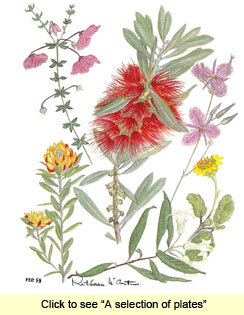
These exact and beautiful colour-plates, which form only a very small part of Kathleen McArthur’s devoted work in wildflower painting, form an excellent introduction to the study of Queensland flowers, particularly for the southern coastal areas where she has mainly worked. If we use them to show us where and when to look for our wildflowers, we will soon begin to recognise their beauty; but when we do find them, let us leave them where they are to seed and grow naturally. Such striking flowers as our Hibiscus splendens, or the richly purple Hovea of the coast, would look well in our gardens, perhaps, but they are better ordered from nurseries which can supply them without denuding their native growing-grounds. What we shall soon need––what we need now, with our increasing urbanisation––is more wildflower reserves, more parks, and sanctuaries where these flowers can be seen as they should be, in their own environment; and if we use this book well, we will soon be demanding these, and also demanding more and larger popular guides to our wildflowers and their places and seasons of blooming. We will teach our children, too, to take care of these flowers and love them. They are, after all, unique in the world’s flora, and many of them grow nowhere else.
Judith Wright
Reproduced with permission of Hugh McAthur
Author’s Preface, in Kathleen McArthur Queensland wildflowers: a selection, 1959, Brisbane, Jacaranda Press
Queensland wildflowers deserve more than this small book, but as finance for large works with coloured illustrations is not readily available, this selection may serve as an introduction to the subject. Its sixty flowers in colour with additional flowers from the Wallum drawn on the endpapers are but an infinitesimal part of the whole. The native flowers of this State lack neither numbers nor quality, only publicity.
While publicity for the wildflowers of Western Australia began nearly three hundred years ago with William Dampier, Queensland wildflowers are still practically unknown. Early this century Mrs Ellis Rowan painted a number of our flowers, some of which were used to illustrate ‘The Comprehensive Catalogue of Queensland Plants’ by Bailey, and more were hung in the Queensland Museum. In the twenties Mrs Estelle Thomson brought out a small booklet with delightful water-colour and line-drawing illustrations. This was to be the first of a series but unfortunately the financial depression that followed prevented further publication. These two efforts appear to be all that has been done to make Queensland wildflowers known to the public. Therefore, this little work is apparently the first popular book on Queensland wildflowers.
The State has been known for its fine botanists whose technical publications serve the specialist, yet little has previously been done to bridge the gap between scientist and the public. It is the general public who, in the end, are responsible for the preservation of our floral heritage, and the delay in serving them could be vital.
The wildflowers of a nation play a big part in its culture. Indigenous culture grows as slowly to maturity as the long-living trees of the forest. Ours is still young and delicate and we must save the heritage of the land to nurture it. What is not recognisable will not be saved. So, with great urgency let us get to know our wildflowers and it will follow that we will love them and desire their preservation.
The following text is written mainly for Caloundra. The times and habit of flowering differ within a few miles and therefore generalised information is unreliable for most areas of the State. The only exceptions to be found are on Plate IX which includes flowers found at The Summit on the Granite Belt.
For those readers unfamiliar with the name, Wallum is the usually flat, badly drained sandy country of the coast. It is an aboriginal word some say applied to all species of Banksia, and others say to Banksia aemula. The Wallum, being up to the present practically useless for commercial purposes provides our best wildflower shows; due, of course, to lack of interference from man and his introduced beasts.
In bushland ecology native flowers and their fruits are an essential link, for without them certain insects, animals and birds would not survive. The National Parks are here the most important aspect of preservation. Their work can be extended with benefit to all by sympathy and emulation from local authorities, groups and individuals until, as in Western Australia, the entire State becomes wildflower conscious. That is the ideal.
Kathleen McArthur
‘Midyim’, Caloundra, Queensland
Reproduced with permission of Hugh McAthur