




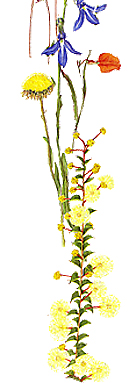
- Estelle Thomson
- The poet's eyes
- The well-kept secret
- A child’s paint-box
- Publishing
- A show in Sydney
Lunch Hour Theatre Script One Life, August 1995
One Life, August 1995, pp 7–8
[On wildflower painting, and the influence of Estelle Thomson]
1946 brought such peace…At last I met Estelle Thomson whose family had a weekender on the headland and had published a charming little wildflower book in 1929, with familiar local species in water-colours and still available from Barker’s bookstore. Why hadn’t I seen it? I was a Barker’s customer!
It is a sad story and I feel for her after all this time. She writes in her preface:
This small booklet is in no sense of the words a botanical textbook. It is issued by one flower-lover in the hope that others similarly inclined may be glad to recognize in it some familiar friends of bush and wayside. It is hoped that this may be the first of a short series of similar booklets, and for this reason many popular favourites have been held in reserve to appear at a later date. When the series is complete the separate numbers might be bound together to form a single volume.
But, there yer go! She had organised wildflower shows in Brisbane, had written articles accompanied by her pen and ink drawings for the Courier, always willing to promote our own floral wealth, so what went wrong? It was the cursed myth––‘there are no wildflowers in Queensland’. You have to go to W. A., go to Kings Park; people had the propaganda off pat, all unaware that King’s Park had lost its display––it takes more than a P.A.R.K. to keep earth flowering. It was to be around the 1980s that it was replanted for display. It was and still is a powerful myth.Reproduced with permission of Hugh McArthur; courtesy of Caloundra City Libraries
© WPSQ, Sunshine Coast & Hinterland Inc
Lunch Hour Theatre Script Wildflowering in June, [no date]
Wildflowering in June [n.d.], p 4
[A script based on Kathleen’s wildflowering diary]
13 June
…What I find most noticeable after fire is the use of wildflowers in the balance of nature. It is the wildflower that holds the sand dunes together; the wildflower that will germinate on eroded land and the wildflower that will spring up through the ashes of a fire. It is the wildflower, then, that nurses the soil in the first stages of its return to health. And the importance of the flower is emphasised when the flower-bud is known to open after fire as soon as the leaf-bud.
The blind, the upward hand
Clenches its bud,
What message does death send
From the grave where he lies?
The poet’s eyes will often help us to see a truth, and Judith Wright is a poet whose love for the land is deep-rooted, intellectual and passionate. The love she has for the soil and its welfare is an important part of her life and so is everywhere evident in her poetry.
The flower begins in the dark
Where life is not.
Death has a word to speak
And the flower begins.
And again,
Open green hand, and give
the dark gift you hold.
[From Dark Gift in Judith Wright A Human Pattern: Selected Poems, 1996, Sydney, ETT Imprint]
Reproduced with permission of Hugh McArthur; courtesy of Caloundra City Libraries
© WPSQ, Sunshine Coast & Hinterland Inc
Lunch Hour Theatre Script When the Mind Opens the Flowers Bloom, [no date]
When the Mind Opens the Flowers Bloom, [n.d.], p 4
[On the ignored legacy of the early botanists, and the well-kept secret of Queensland wildflowers]
Great, as undoubtedly was the Endeavour team led by Captain James Cook, that of the Investigator under the command of Captain Matthew Flinders was at least its equal, including as it did the greatest of botanists and the greatest of botanical artists…
When the Mind Opens the Flowers Bloom, [n.d.], p 9
The hoodoo, the restraint, or whatever it was that has prevented the flora of Queensland from receiving its rightful, its deserved credit, can now be clearly seen. There have been two of the greatest teams of navigator, scientist and artist in all history, travelling more than ten thousand miles of danger and hardship to work with great skill, diligence and excitement, only for it all to be kept from the world and for no good reason either. It was as though the Fates conferred and their judgment declared that as none could beat these, so they must be severely handicapped.
The pattern was set. The dye [sic] was cast. It has survived and become a part of established acceptance. No one can change it. The flora of Queensland is a well-kept secret; it is esoteric and can be seen only by a few––the cabala of those who can open their minds to see the flowers bloom.
Reproduced with permission of Hugh McArthur; courtesy of Caloundra City Libraries
© WPSQ, Sunshine Coast & Hinterland Inc
The North-West Star 21 June 1967
Never thought of it before
HOMEWORK BEGAN HER PAINTING
Flowers and birds had never crossed the mind of Mrs. Kathl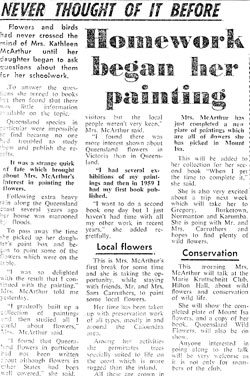 een McArthur until her daughter began to ask questions about them for her schoolwork. To answer the questions she turned to books but found there was little information available on the topic. It was a strange quirk of fate which brought about Mrs. McArthur’s interest in painting the flowers. Following extra heavy rain along the Queensland coast several years ago her house was marooned by floods. To pass away the time she picked up her daughter’s paint box and began to paint some of the flowers which were on the table. ‘I was so delighted with the result that I continued with the painting,’ Mrs. McArthur told me yesterday. ‘I gradually built up a collection of paintings then studied all I could about flowers,’ Mrs. McArthur said. ‘I found that Queensland wildflowers in particular had not been written about although flowers in other States had been well covered,’ she said.
Publishers
Finally Mrs. McArthur had the idea of producing a book on Queensland wildflowers and sent her paintings and a manuscript to several publishers. ‘The trouble was that they all said it would be too expensive to produce the book in colour,’ Mrs. McArthur said. ‘They all agreed that if I would include flowers from other States they would be interested but I wanted to promote Queensland flowers. ‘I wanted to know just how much it really would cost so I sent the whole lot to a publisher in Adelaide and they told me it would cost between $40,000 and $60,000 to print. ‘In the end I decided to have some of my paintings printed for sale but these were rather slow in selling.
During this time Mrs. McArthur’s interest in flora and fauna had grown and she became an active founder member of the Queensland Wildlife Preservation Society in Brisbane. She also turned one of the rooms in her Caloundra home into a gallery where she exhibited her paintings to the public, during the tourist season mainly. ‘There was a lot of interest at first, mainly from visitors but the local people weren’t very keen.’ Mrs. McArthur said. ‘I found there was more interest shown about Queensland flowers in Victoria than in Queensland. ‘I had several exhibitions of my paintings and then in 1959 I had my first book published. ‘I want to do a second book one day but I just haven’t had time with all my other work in recent years,’ she added regretfully
Local Flowers
This is Mrs. McArthur’s first break for some time and she is taking the opportunity, while staying with friends, Mr. and Mrs. Sam Carruthers, to paint some local flowers. Her time has been taken up with preservation work of all types, mostly in and around the Caloundra area. Among her activities she germinates trees specially suited to life on the Coast, which is more rugged than the inland. All these are grown in her own garden and this takes up a great deal of time. Apart from that she is secretary of the Caloundra Branch of the Wildlife Preservation Society.
Mount Isa will gain something from Mrs. McArthur’s stay in the district. Mrs McArthur has just completed a new plate of paintings, which are all flowers she has picked in Mount Isa. This will be added to her collection for her second book ‘When I get the time to complete it,’ she said. She is also very excited about a trip next week, which will take her to Gregory, Burketown, Normanton and Karumba. She is going with Mr. And Mrs. Carruthers and hopes to find plenty of wildflowers.
Conservation
This morning Mrs. McArthur will talk at the Marie Kruttschnitt Club, Hilton Hall, about wild flowers and conservation of wild life. She will show the completed plate of Mount Isa flowers, and a copy of her book, Queensland Wild Flowers, will also be on show. Anyone interested in going along to the talk will be very welcome as it is not only for members of the club.
Reproduced with permission of Carpentaria Newspapers, publishers of The North-West Star
© WPSQ, Sunshine Coast & Hinterland Inc
Lunch Hour Theatre Script One Life, August 1995
One Life, August 1995, pp 9–11
[On wildflower painting: the beginnings, and the publication of Queensland Wildflowers–A Selection]
[After returning from Africa in late 1949]
Mt Mee had wildflowers; the hills were forested. The only public building was the local hall and time was everywhere just waiting to be used.
It was there I taught myself to paint wildflowers in watercolour, added to which, found in Thompson’s Queen St. Bookstore, The Art of Botanical Illustration by the world authority Wilfred Blunt. The 1950s were set to be a very special period of my life, so come along with me.
Of first importance was to get my general knowledge in order, next to paint towards improvement, do as many black and white drawings for illustrating articles, gather popular names for the flowers in people language while keeping the scientific classification in a handy pocket, to use this precious TIME.
Articles went off to the Courier-Mail and Country Life, which were accepted and I jumped at an offer to tell stories on the ABC, stopping at three, as I really was not ready for that. Publicity brought requests to speak to clubs and schools. The flower painting needed constant work for improvement. Despite what was said earlier, specimens were picked, as they needed to be pressed for sending to the Herbarium for classification. Right from the word go I aimed to publish a wildflower book. Testing work for appraisal, some plates were sent to an Adelaide publisher, the response to which was anything but flattering, but that didn’t worry me as they were each only one flower whereas I had already become aware that wildflowers were depicted in bunches, in the public taste, as were Gumtips with Jerberas, whereas I was following my book on botanical art based on the British Museum of Natural History, with some compromise. Work on the book was finished in 1959.
Queensland Wildflowers––A Selection was taken direct to the Griffin Press, ignoring the publishing houses, while the manager helped me to design it. The first launching was in Melbourne where friends had arranged a showing in the Joshua McClelland Print Room in Collins Street accompanied by press and television interviews. In Brisbane Watty Thomson gave me a ‘do’ in the gallery of his Queen St. Bookstore covered by the Courier-Mail Arts reporter with about four lines. To see ourselves as others see us! In the three-column-wide interview in the Melbourne Age was this description of me: ‘slightly built, grey haired woman with a lively mind’. Me! Not yet 45!
Lunch Hour Theatre Script The Female Gender of Wildflowers, May 1996
The Female Gender of Wildflowers, May 1996, pp 1–3
[Looking back to the publication in 1959 of Queensland wildflowers: A selection and subsequent promotion]
There is something about simple wildflowers that inspires enthusiasm, as friends in Melbourne arranged a hanging for me in the Joshua McClelland gallery in Collins Street, to coincide with the launching and the Press. The Age of November 12, 1959 begins with the following introduction:
A Queensland woman now in Melbourne is having a book published this week and an exhibition of paintings hung next week––both devoted to Queensland wildflowers. This is part of her self-appointed task to promote flowers of her State.
It was all very complimentary, with three columns for me and a photograph.
One would not expect anything of such style in Brisbane, but bookseller Watty Thomson of Queen Street provided space for a wide collection in his shop and the noted Gertrude Langer gave me an interview and added a short appreciation in the Courier-Mail.
It must have been just coincidence, but the National Library in Canberra also involved itself by association with Sir Joseph Banks and his life interest in Australian flora and fauna, especially the Investigator survey with botanist Robert Brown, artist Ferdinand Bauer, commanded by Matthew Flinders in the first decade of the 19th century.
Queensland wildflowers: A selection was part of that display and [it was] only by good luck that I saw it…
The buzz you may be hearing was the ‘kick-start’ that got the ball rolling for thirty years, thirty years devoted to the ‘art of seeing’. Seeing what had been invisible to many because it had never been imprinted on the mind that couldn’t see for itself.
Reproduced with permission of Hugh McArthur; courtesy of Caloundra City Libraries
© WPSQ, Sunshine Coast & Hinterland Inc
Nambour Chronicle 8 August 1980
Coast Line––with ‘Pamela’
MCARTHUR PAINTINGS IN SYDNEY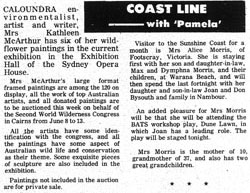
Caloundra environmentalist, artist and writer Mrs Kathleen McArthur has six of her wildflower paintings in the current exhibition in the Exhibition Hall of the Sydney Opera House.
Mrs McArthur’s large format framed paintings are among the 120 on display, and all donated paintings are to be auctioned this week on behalf of the Second World Wilderness Congress in Cairns from June 8 to 13.
All the artists have some identification with the congress, and all the paintings have some aspect of Australian wildlife and conservation as their theme.
Reproduced with permission of Sunshine Coast Newspapers
© WPSQ, Sunshine Coast & Hinterland Inc