




- Practising what she preaches
Sunshine Coast Daily [early 1980s]
Thursday Magazine: Conservation
PRACTISING WHAT SHE PREACHES, by Barbara Hansa
With the theme for World Environment Day this year towar ds a conserver society, it seems appropriate to write about a person for whom conservation is a way of life.
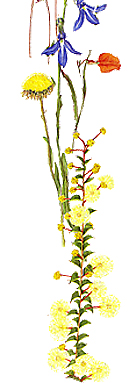
Kathleen McArthur is well-known as a writer, wildflower artist and a tireless campaigner for the natural environment. For many years it was a one-woman campaign, beginning in the 1940s with her concern about the wholesale destruction of the sand dunes.
Understanding of beach ecology was non-existent in those days. The sand dunes were being bulldozed out of existence and people could not understand why anyone should make a fuss about that. After all without the obstruction of the dunes one could enjoy a view of the ocean without having to leave the car. Despite the apathy and sometimes even hostile reaction to her pleas for the preservation of the dunes and foreshores (a typical comment was from a Council who admonished her not to be childish), Kathleen’s concern for the beaches increased. However, it was to be a lonely fight for many years. The Beach Protection Authority was formed only thirteen years ago.
It was a similar story with the wildflowers, and particularly the beloved wallum. Dismayed at the destruction of the wallum wildflower habitat for ill-sited, poorly planned housing developments, Kathleen intensified her study, writing and painting of the wildflowers.
To use her own words from the preface to her book, Queensland Wildflowers, Jacaranda Press, 1959, ‘The Wildflowers of a nation play a big part in its culture. Indigenous culture grows as slowly to maturity as the long-living trees of the forest. Ours is still young and delicate and we must save the heritage of the land to nurture it. What is not recognisable will not be saved. So, with great urgency let us get to know our wildflowers and it will follow that we will love them and desire their preservation’.
After the founding of the Wildlife Preservation Society of Queensland in 1962 (Kathleen, Judith Wright, David Fleay and Brian Clouston were co-founders) the battle was not quite such a lonely one, but it became an increasingly desperate one with increasing destruction of the coastal strip by developers in the name of progress.
The story is different now with active conservation groups from Caloundra to Noosa. Symptomatic of community concern is Maroochy Shire Council’s determination to have part of Suncoast Development’s holdings set aside as a wildflower reserve.
‘It isn’t until people realise that they’ve lost something, but they begin to value it. There is more hope now, that much of what remains may be saved, or at least that future development will be planned and carried out in a more environmentally sympathetic way,’ Kathleen McArthur said. ‘There is never sufficient hope to relax, even a national park can be revoked by Act of Parliament. Nothing is safe if someone bright covets it.’
The foregoing has given a more incomplete sketch of the lifelong dedication and work of a remarkable woman, Kathleen McArthur, conservationist. But there is another side to conservation and another side to Kathleen, which few people are aware of.
Looking at Midyim, Kathleen’s comfortable chamferboard house at King’s Beach, one would not immediately be aware that the lifestyle of its owner was different from others. Certainly she must be a little eccentric to have all those trees and shrubs growing in such a jungle that you can hardly see the house, but…
An observant sleuth, however, would notice that although Caloundra has a twice-weekly garbage collection there are rarely any bins to be emptied at Midyim even though the house is occupied. The fact that there is no accumulation of rubbish at Midyim for the garbage collectors is evidence of the other side of conservation in practice––an old fashioned form of conservation which was important to our grandmothers, but which was easily forgotten, even scoffed at, during the prosperous affluent decades following World War II.
When shopping Kathleen takes her own basket and paper bags. She refuses the smart plastic shopping bags in which many retailers pack goods. In fact she avoids over-packages altogether, and she particularly avoids plastic. Only liquids in glass bottles or jars are bought. Kathleen explains that unlike glass, plastic cannot be recycled. It is not biodegradable and when burnt it gives off noxious fumes. Because milk comes in plastic-coated cartons Kathleen uses evaporated milk, which comes in cans which can be bashed, buried and will rust away. Greasy papers and food scraps are buried in the garden. Bottles and any other glass are taken to the city rubbish dump at Caloundra where licensed dealers collect them for recycling. Cardboard and clean waste paper is taken to an Endeavour Workshop bin for recycling. It is impossible to avoid plastic altogether. The few bits such as cheese wrapping which do come in to the house are lightly screwed up in a bag and buried. The only items ever put into the garbage bin are torch batteries (they don’t get recycled), and bits of litter picked up from the street outside Midyim.
Of particular concern is the amount of water wasted in most households. The laundry, bathroom and kitchen at Midyim are connected to the town water supply. In addition, there is a rainwater tank to provide drinking water and cooking. But because of the enormous cost and destruction involved in impounding water to bring it to urban areas, Kathleen is as careful as any countrywoman to conserve water. She is also concerned about the damage to the environment caused by excess water from drains and sewers.
Perhaps we’ve given ourselves more trouble than it’s worth with all our electric appliances and gadgets. Perhaps the old ways were simpler and better; Kathleen certainly thinks so.
Reproduced with permission of Barara Hansa and Sunshine Coast Newspapers
© WPSQ, Sunshine Coast & Hinterland Inc