



- Growing and showing
- Opening the mind
- Why this show
- On the day
- Wildflowers '69
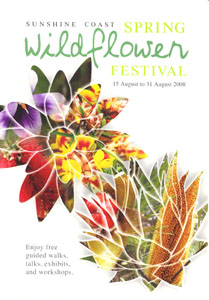
- Wildflower Festival
During the early 1960s a WPSQ native plant nursery at Kathleen McArthur’s Caloundra home filled a need for local species in the absence of commercial or council nurseries. Visitors came to buy or order plants for gardens, golf courses and footpaths.
Sales became part of a new venture––a Wildflower Show, with Kathleen’s paintings and legally collected local wildflowers displayed in the ‘Wildflower Room’ at Midyim. Thousands of attendees gained an appreciation of the Coast’s natural resources. The first Show was held in August 1967, sowing the seeds of the current Sunshine Coast Wildflower Festival held each August. WPSQ continues to participate in this festival with local wildflower walks, especially in the Currimundi (Kathleen McArthur) Conservation Park.
© WPSQ, Sunshine Coast & Hinterland Inc
Sunshine Coast Weekly Advertiser 20 July 1967
Wildlife and Landscape
QUEENSLAND WILDFLOWERS
Queensland wildflowers [are] equal in quality and q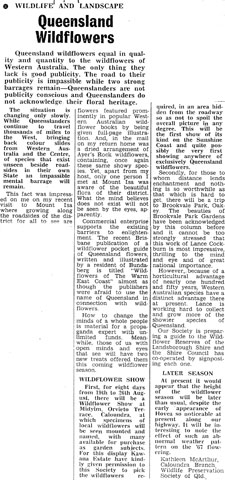 uantity to the wildflowers of Western Australia. The only thing they lack is good publicity. The road to their publicity is impassable while two strong barrages remain––Queenslanders are not publicity conscious and Queenslanders do not acknowledge their floral heritage.
The situation is changing only slowly. While Queenslanders continue to travel thousands of miles to the West, bringing back colour slides from Western Australia and the Centre, of species that exist unseen beside roadsides in their own State an impassable mental barrage will remain. This fact was impressed on me on my recent visit to Mount Isa where growing along the roadsides of the district for all to see are flowers featured prominently in popular Western Australian wildflower books by being given full-page illustration. And, in the mail on my return home was a dried arrangement of Ayer’s Rock wildflowers, containing, once again these same showy species. Yet, apart from my host, only one person I met at Mount Isa was aware of the beautiful flora of their district. What the mind believes does not exist will not be seen by the eyes, apparently.
Commercial enterprise supports the existing barriers to enlightenment. The recent Brisbane publication of a wildflower pocket guide of Queensland flowers, written and illustrated by a resident of Bundaberg, is titled ‘Wildflowers of the Warm East Coast’, almost as if the publishers were afraid to use the name of Queensland in connection with wildflowers.
How to change the minds of a whole people is material for a propaganda expert with unlimited funds. Meanwhile, those of us with open minds and eyes that see will have two new treats offered them this coming wildflower season.
Wildflower ShowFirst, for eight days from 19th to 26th August, there will be a Wildflower Show at Midyim, Orvieto Terrace, Caloundra, at which specimens of local wildflowers will be seen mounted and named, with many available for purchase as garden subjects. For this display Kawana Estate have kindly given permission to this Society to pick the wildflowers required, in an area hidden from the roadway so as not to spoil the overall picture in any degree. This will be the first show of its kind on the Sunshine Coast and quite possibly the very first showing anywhere of exclusively Queensland wildflowers.
Secondly, for those to whom distance lends enchantment and nothing is so worthwhile as that which is hard to get, there will be a trip to Brookvale Park, Oakey. The beauties of Brookvale Park Gardens have been acknowledged by this column before, and it cannot be too strongly stressed that this work of Lance Cockburn is most impressive, thrilling to the mind and eye and of great national importance. However, because of a horticultural advantage of nearly one hundred and fifty years, Western Australian species have a distinct advantage there at present. Lance is working hard to collect and grow more of the showier species of Queensland.
Our Society is preparing a guide to the Wildflower Reserves of the Landsborough Shire and the Shire Council has co-operated by signposting each one.
Later SeasonAt present it would appear that the height of the wildflower season will be later than usual, despite the early appearance of Hovea, so noticeable at present along our highway. It will be interesting to note the effect of such an abnormal weather pattern on the ’67 flowering.
Kathleen McArthur
Wildlife Preservation Society of Queensland, Caloundra Branch
Reproduced with permission of Sunshine Coast Newspapers
© WPSQ, Sunshine Coast & Hinterland Inc
Sunshine Coast Weekly Advertiser 17 August 1967
WILDFLOWER NEWS: Supplement of the Weekly Advertiser
WHY THIS SHOW
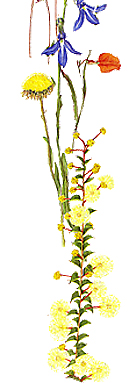
The aim of this show is to single out the wildflower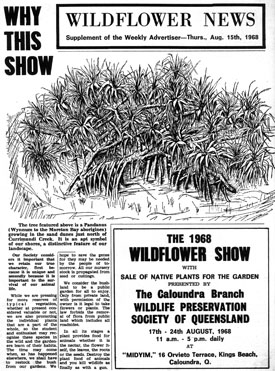 s of the Sunshine Coast, with their common names and botanical names and present them, in living form, in the same room as they are depicted in water-colour paintings. It is our hope that by doing this, those who view this show will appreciate them more, and later gain more from seeing them in their bushland setting.
In the past year, local reservations for the preservation of wildflower habitat have been considerably increased in acreage, so that we now know that the people of the future will be able to enjoy at least a small proportion of our total heritage.
Horticulture is concerned more with the spectacular, whereas, in the overall pattern of the landscape the small and, so far as the garden is concerned, insignificant flowers play an equal part in the character of the whole pattern. For instance Siebera linearifolia, while being one of the smallest of wildflowers when seen flowering together with Mirbelia reticulata (if these species were more spectacular they would surely have common names!), may create an unforgettable picture in the mind of those who stumble on them when crossing a swampy section of our wallum. They will not be seen by the passengers of a car travelling at 50 mph, as will Christmas Bells or wallum Boronia. They would never graduate to the pages of the popular magazines nor is it likely they would be presented to the public on picture postcards, but they too are loveable—they too are worth knowing.
There are flowers peculiar to the rocky headlands; others such as Beach Stackhousia, Beach Bean, Goatsfoot and Scented Fan-flower are characteristic of unspoiled beaches and their dunes. The wildflower plains will present the greatest number of flowers within a given range, but others may be seen only as the undercover in Eucalyptus forests.
Rainforests add still more, mainly in the form of climbers such as Bower-of-Beauty, Wonga Vine, Wisteria and Clematis, which having struggled through the dim light to the sunlit canopy of the forest, drop their blooms on the track where we walk. There is flowering everywhere, for without flowering regeneration would cease. Sometimes an eye-glass or plastic ‘nature viewer’ may be needed to see, through magnification, the beauty indiscernible by the human eye.
The world of wildflowers awaits, to give to us, and be given our love and attention.
Reproduced with permission of Sunshine Coast Newspapers
© WPSQ, Sunshine Coast & Hinterland Inc
Lunch Hour Theatre Script The Female Gender of Wildflowers, May 1996
The Female Gender of Wildflowers, May 1996, pp 10, 11
[On the Wildflower Shows at Midyim]
Picture a little cottage surrounded by trees. There is a small terrace and two glass doors opening into a large green-walled room full to overflowing with watercolour paintings of wildflowers. For displaying fresh blooms there is a two sided wooden arrangement with cut-out holes backed by containers of water for keeping displayed flowers fresh. That was planned as the main attraction, but was strongly rivalled by the ground outside being covered with forms of potted plant seedlings.
Our advertising supplement read: ‘A Wildflower Show, combining a sale of native plants for the garden, 19th–26th August, 1967, 11 am–4 pm daily’.
What was not prepared for was the importance of those seedlings. Armed with the Advertiser supplement with its printed list of species available, they came bursting in at 8 am. It seemed that nurseries were not catering sufficiently for native plants, especially for coastal growing, and having driven all the way from Gladstone or Toowoomba, Bundaberg or most likely Brisbane, they were not going to be beaten by the bells, no way!
It was all very exciting. The days began at first light, bringing in fresh specimens and it wasn’t finished until the last guest/customer might decide it was too dark to see; he would ‘come back in the morning’.
The size of the crowds we brought in was most impressive, especially to the Chamber of Commerce. Talking down to the instigator of this bonza boutique, it was explained how it could be done better by presenting it later in the year when commerce was quiet. So it was carefully explained to this Captain of Industry that August produced the greatest variety of flower species. He was not impressed; flowers were considered of the least importance compared with crowds...
…When these shows began in 1967, flowers were everywhere, by the roadside, on vacant land, on unmown footpaths, especially attractive to the little ground orchids until the Council began to behave like a busy housewife, tidying-up everything in sight. A tree had to be shaped, a shrub trimmed, and the rest mown flat. It was really very funny, but sad to lose old friends like lady’s Tresses and Nodding Greenhoods.
Reproduced with permission of Hugh McArthur; courtesy of Caloundra City Libraries
© WPSQ, Sunshine Coast & Hinterland Inc
Sunshine Coast Weekly Advertiser 14 August 1969
WILDFLOWER NEWS: Supplement of the Weekly Advertiser
WILDFLOWERS ‘69
Once again we present the public with a showing of their own living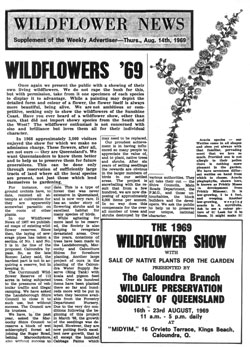 wildflowers. We do not rape the bush for this, but with permission, take from it one specimen of each species to display it to advantage. While a painting may depict the detailed form and colour of a flower, the flower itself is always more beautiful, being alive. We are not ambitious or competitive, seeking only to show the wildflowers of the Sunshine Coast. Have you ever heard of a wildflower show, other than ours, that did not import showy species from the South and the West? The wildflower enthusiast is not concerned with size and brilliance, but loves them all for their individual character.
In 1968 approximately 3,000 visitors enjoyed the show, for which we make no admission charge. These flowers, after all, are not ours––they are Queensland’s. We want Queenslanders to know them better and to help us preserve them for future generations. This can be done only through reservation of sufficiently large tracts of land where all the local species are present, not just those which lend themselves to gardening. For instance, our ground orchids have, to date, resisted all attempts at cultivation, for they are somewhat parasitic on the roots of other plants.
In our Wildflower News of 1967 we published maps of existing wildflower reserves. Since then, the laying of sewerage pipes has taken a section of No. 1, and No. 2 is in the line of the proposed Caloundra bypass. So, as the late Romeo Lahey said, the hardest part is not in acquiring a reserve, but in keeping it. The Currimundi Wildflower Reserve of 112 acres is being subjected to the pressures of vehicular traffic and illegal camping. We have asked the Landsborough Shire Council to close it to such use, but without success. The Council are its trustees. We have, in the past year, asked the Maroochy Shire Council to reserve a block of wet schlerophyll forest adjoining the Sugar Road, behind Maroochydore, also without success to date. This is a type of forest that was never extensive in Queensland, and is now very rare. It has an under-story of flowering shrubs and is an excellent habitat for many species of birds.
While agitating for more land to be reserved, the Society is also helping to revegetate devastated areas. Over the years, donations of trees have been made to the Landsborough, Maroochy and Caboolture Shires for foreshore planting. Another large project of ours is the planting of the Caloundra Water Supply Reserve (Ring Tank) with koala and pigeon feed trees. Over six hundred items have been planted there so far and hundreds more will be put in when they become available from the Forestry Department Nursery. Due to the very dry conditions following the beginning of this project in March ’68, the growth of the seedlings was delayed. However, they are now putting forth excellent new growth, that is all except the hundred Cabbage Palms, which may need to be replaced.
Our proudest achievement is in having influenced so many people to appreciate the value of, and to plant, native trees and shrubs. After six years of selling seedlings the rewards are obvious in the larger numbers of birds in our settled areas. The project is snowballing with the result that from a few hundred, we are now disposing of approximately 6,000 items per annum. In no way does this compensate for the overall number of trees and shrubs destroyed by the various authorities. They all take their cut––the Shire Councils, Main Roads Department, the P.M.G., and those untouchables, the block builders and the developers. We ask the public to help us to preserve our unique, national character.
Reproduced with permission of Sunshine Coast Newspapers
© WPSQ, Sunshine Coast & Hinterland Inc